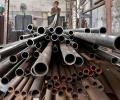
The imposition of safeguard duty, an uptick in exports, and an increase in input cost are driving steel prices higher. The latest round of price increase took place on Friday, with some steel mills increasing hot-rolled coil (HRC) prices by ~500-750 a tonne, according to price reporting and market intelligence firm BigMint. HRC is a benchmark for flat steel.

FDI inflows into India are expected to register robust growth in 2026, supported by strong macroeconomic fundamentals, big-ticket investment announcements, sustained efforts to improve the ease of doing business, and a new generation of investment-linked trade pacts.

The Committee of Creditors have issued ArcelorMittal and its partner Japan's Nippon Steel & Sumitomo Metal Corp a Letter of Intent declaring them as the "successful applicant".
The Indian steel industry is faced with a paradox: Rising demand and falling prices. Demand continues to surge as user industries gather pace, with the World Steel Association projecting around 9 per cent annual growth for India over 2025 and 2026, the year domestic demand is projected to be almost 75 million tonnes (mt) higher than in 2020.

From setting up cutting-edge facilities to cater to the domestic market and building capabilities of global standards, the action is building up.

India, the world's fourth largest economy, is set to maintain the 'goldilocks' phase with tailwinds of good growth, low inflation and robust banking performance as well as reform initiatives poised to sustain the economic pace witnessed during 2025.

Apart from being the most successful cases under the IBC, Bhushan Steel and Essar Steel are among the best steel assets in the country. They also ended up helping their lenders get back a significant chunk of the money while allowing Tata Steel to consolidate its position and giving the world's two largest steel makers - ArcelorMittal and Nippon Steel - a strong foothold in India. A significant contrast was the pace at which these two cases were resolved under the bankruptcy code. In the annals of the Insolvency and Bankruptcy Code (IBC), Essar Steel may go down in history as the most noticeable resolution with the world's largest steelmaker, ArcelorMittal, and the incumbent, Ruia family, locked in an intense battle spanning more than two years and ultimately resulting in full recovery of the principal amount for the financial creditors.

India on Monday imposed a 12 per cent provisional safeguard duty for 200 days on five steel product categories, including hot rolled coils, sheets and plates, to protect domestic players from surge in imports. The decision follows a recommendation for the same by the Commerce Ministry's investigation arm DGTR. Last month, the DGTR suggested to impose the duty.
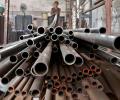
Domestic steel prices have seen an increase over the past couple of months in anticipation of a safeguard duty, but a looming global trade war is likely to weigh as threat of import rises and prospect of export flounders. Data from BigMint showed that in March 2025, hot rolled coil (HRC) prices ex-Mumbai increased by Rs 600 per tonne month-on-month (M-o-M), rising from Rs 48,400 per tonne in February to Rs 49,000 per tonne.
Essar group on Friday announced the signing of a USD 2.4 billion (Rs 19,000 crore) deal to sell certain ports and power infrastructure to ArcelorMittal Nippon Steel in one of the largest post-pandemic merger and acquisition deals in India. In a statement, the Ruia-run firm said the deal also envisages a 50-50 joint venture between Essar and ArcelorMittal for building a 4 million tonnes a year LNG import terminal at Hazira in Gujarat. Without giving details, it only identified certain ports and power infrastructure that are primarily captive to operations of the Hazira steel plant, which was acquired by ArcelorMittal Nippon Steel (AM/NS) in 2018-19, as part of the deal.
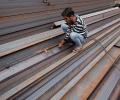
Raw material prices had been on the rise, but since Russia waged war on Ukraine, prices have surged.
India's leading steel companies hope the Modi 3.0 Budget will continue the massive capital expenditure currently underway, focusing on infrastructure development, manufacturing, and fair trade. The infrastructure segment is the largest steel user, and the government's focus has fuelled steel consumption even as international markets have underperformed. According to provisional statistics, steel consumption grew 13.6 per cent in FY24, reaching 136 million tonnes (mt), according to a CRISIL report.
The "weaponisation" of economic activity - through tariffs and sanctions - is now a reality, with countries leveraging these tools strategically, External Affairs Minister S Jaishankar said at the Raisina Dialogue recently.
India's steel market is out of step with global trends. Global demand is weak with China at a huge supply surplus to its domestic demand, pushing down global steel prices. India's domestic demand for steel is strong, given the continuing infrastructure push and is likely to accelerate as urbanisation improves, and the auto sector continues to grow alongside the infrastructure push.
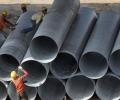
Strong demand in the domestic market, coupled with an increase in raw material prices, is pushing up steel prices. According to SteelMint, a market intelligence and price reporting firm, the list price of flat steel has seen an increase of Rs 750-2,000 per tonne for October deliveries. The long steel price witnessed an increase of Rs 1,500 per tonne towards the end of September.
On June 30, mining and metals giant Vedanta, announced that it had decided to initiate a strategic review of its steel and steel-making raw material businesses. The review would begin immediately and evaluate a broad range of options, including but not limited to a potential strategic sale of some or all of the steel businesses, the company said in its stock exchange filing. The signs have been there - approaches had been made to steel players over the past year. Last December, Anil Agarwal, chairman Vedanta group, told Business Standard that the steel plant capacity was about 3 million tonnes (mt).
Worried by a spike in Chinese imports, the Indian Steel Association (ISA) plans to take up the matter with the government and seek measures to fix "trade distortions". Alok Sahay, secretary general of the group that represents the country's steel producers, said systemic changes were needed. "In order to take any trade measure, it takes a minimum of 15 months' time, due to prevalence of lesser duty rule in India, making India an easy target. "We are going to write to the government on this," he said.
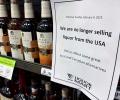
'We have to be prepared for the larger disruption that is likely to take place.'
The festive season will mean business for the steel industry as it is the time when automotive and consumer appliance companies bump up demand to prepare for higher sales, experts have said. Ranjan Dhar, chief marketing officer at ArcelorMittal Nippon Steel India (AM/NS India), said that bookings by auto and consumer appliance industries are 20 per cent higher ahead of the festive season compared to last year. "While this could be for a couple of months, it could normalise later at approximately 10 per cent," he said.

India Ratings expects long products demand growth to be sharp, supported by a demand push from the government-led infrastructure investments in affordable housing, railways, rural electrification and road networks.

Prime Minister Narendra Modi on Wednesday said the world looks at India as an important pillar of stability, a trusted friend, an engine of growth in the global economy, a technology hub for finding solutions and a powerhouse of talented youth. He also said that in the rapidly changing world order, India is moving forward as 'vishwa mitra' (friend of the world). Speaking at the inauguration of the 10th edition of the Vibrant Gujarat Global Summit, which saw participation of state hea

The turnaround of SAIL from several quarters of losses was one of the most challenging experience, said Anil Kumar Chaudhary, the outgoing chairman of the country's largest steel maker. The chairman said he also wants to see SAIL paying back at least 50 per cent of its debt in the near future. Chaudhary who had joined SAIL as a junior manager in 1984 would be superannuating from the top post on December 31, 2020 after serving the company for almost 36 years in various roles.

With the threat of a third Covid-19 wave looming large, companies are scrambling to protect employees and keep operations safe--from a no-jab-no-entry-at-workplace policy to ramping up vaccination, it's an all-out effort to prevent the scale of devastation seen in the first two waves. At least two top steel companies--Tata Steel and ArcelorMittal Nippon Steel India (AM/NS India)--are pushing for vaccination certificates for entry into work premises. AM/NS India, a joint venture between world's leading steelmaker, ArcelorMittal, and Japan's Nippon Steel, is set to make vaccination the certificate a requirement from July 1.

Russia's war on Ukraine has sent steel prices soaring to its highest levels in the domestic market since November 2021. But there is little cheer in the industry. That's because input costs are spiralling out of control, leaving the big boys nearly as high and dry as the small, medium and secondary steel producers. Russia and Ukraine are major providers of steel and raw materials to the world.

How much do you know about the Vibrant Gujarat Global Summit 2024?
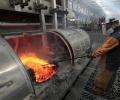
In the domestic segment, demand is currently led by rural markets, oil and gas, LPG and B2C segments like roofing and sheeting.

Corporate India is starting to step up its capital expenditure plans amid government incentives and signs of rising demand, company executives and analysts have indicated. This coincides with the Reserve Bank of India (RBI) recently citing a double-digit growth in private capital expenditure. Healthy balance sheets of banks and corporates, along with increasing capacity utilisation and improving business sentiment, are contributing to a favourable environment for sustained growth in private sector investments, the RBI said in its policy last week.

When the world was upended by the Covid-19 pandemic, metals got its shine back. In the last two years, infrastructure spending by major economies spurred demand, energy transition and intermittent supply disruptions fuelled a scorching rally in metals after a downturn during the first Covid wave. Now, Russia's war on Ukraine is ensuring that elevated prices stay the course.

'The concept of an MP IPL team is the brainchild of Kamal Nath.' 'If the Congress government comes to power in the state, he will assemble an IPL team for MP with the assistance of his business contacts.'
Once Bhushan Steel is into its fold, Tata Steel will increase its capacity from 12.7 million tonnes per annum (mtpa) to 18.3 mtpa

"Lady candidates need not apply." So read the postscript in a job notice from Telco (now Tata Motors) on a notice board in the corridors of the Indian Institute of Science, Bangalore (now Bengaluru), in 1974. Irked, Sudha Murty, who was then pursuing her masters in computer science at the institute, wrote a postcard to JRD Tata, expressing her surprise at this gender discrimination, especially since the Tata Group were pioneers on many fronts. Shortly, Murty became the first woman on the firm's shop floor.

Metal prices from copper to aluminum and tin have shot up by about 7-32 per cent in the past three months.

With the dizzying rise in the number of Covid-19 cases in the country, India Inc has transitioned from a wait-and-watch policy to full-on emergency mode, bringing back remote and flexi work, stringent safety protocols, and allowing only essential travel. Companies - especially in metros like Delhi, Mumbai and Kolkata - that had adopted a hybrid work model during the last few months when the caseload remained low, are either switching back entirely to work-from-home (WFH), or calling skeletal staff to office on select days. Take the case of cigarettes-to-hotels major, ITC, which had been on a hybrid work model over the last few months.

An analysis of the financial performance of nine leading global companies during January-June 2009 showed that only three of them registered profits, with SAIL's profit being the highest.

Yoga guru Baba Ramdev's Patanjali Ayurved on Wednesday made its first big acquisition when it paid Rs 4,350 crore to take over soya food brand Nutrela-maker Ruchi Soya through an insolvency process. The acquisition will help Patanjali acquire edible oil plants as also soyabean oil brands such as Mahakosh and Ruchi Gold.

Hemant Shivsaran lists the number of projects the Modi government has announced since August to woo Gujarat voters.
 © 2026 Rediff.com - Investor Information - Advertise with us - Disclaimer - Privacy Policy - Sitemap - Feedback - About us - Terms of use - Grievances